
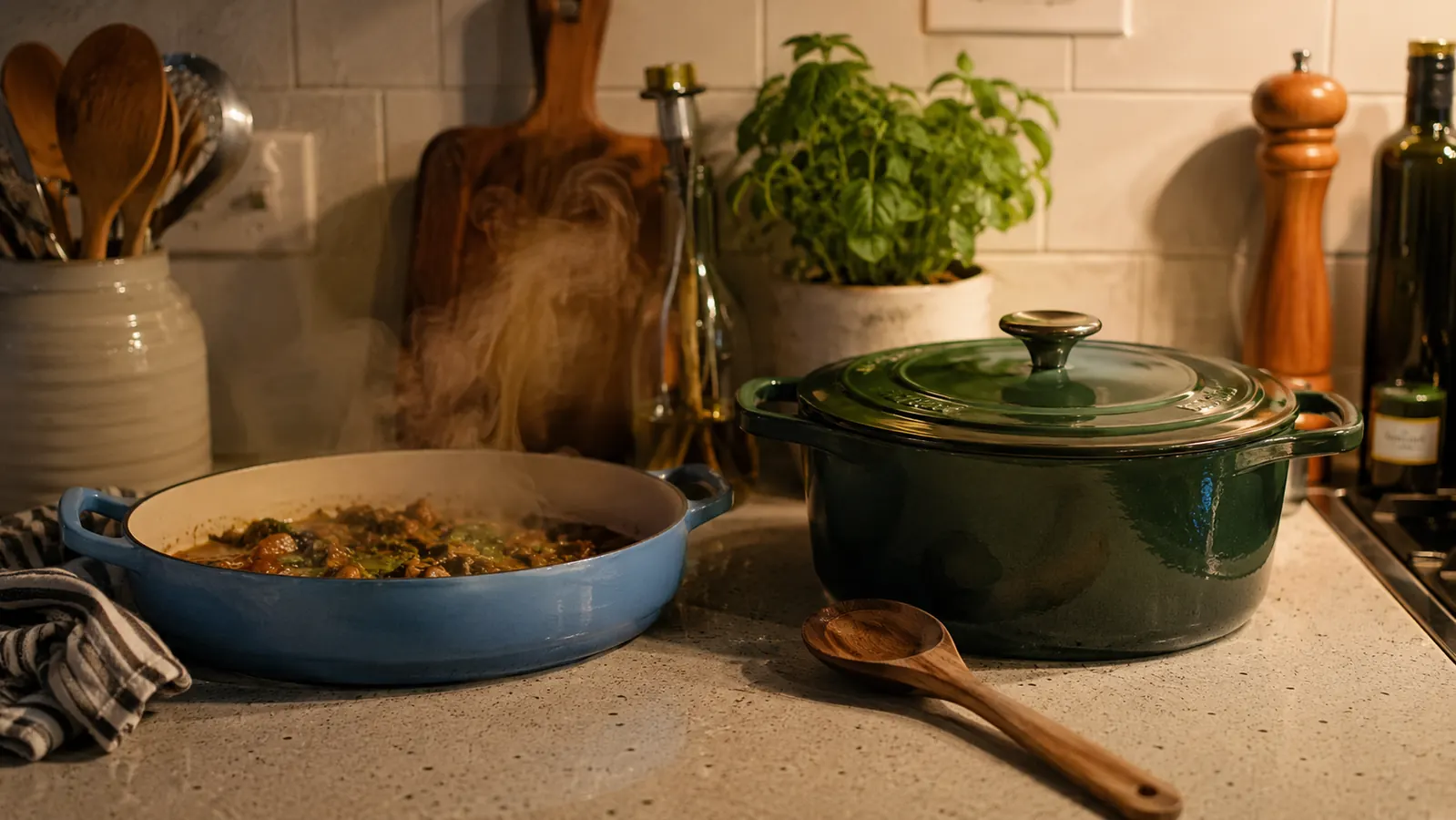
For years I cooked everything in a stockpot that used to belong to a stranger's estate sale, a monster of a Dutch oven that took two hands and most of my patience to lift once it had a pot roast and two cups of stock in it. When I finally admitted my kitchen was never going to fit a proper Dutch oven collection, I went looking for something smaller and landed on the Lodge Essential Enamel Braiser, the 3.5 quart version in that dusty cornflower blue. The question I get most from people eyeing the same shelf space is simple, do you actually need a full-size enameled Dutch oven, or will the Lodge braiser do the job for two or three people cooking on a weeknight. Short answer, if you're cooking for one to three people most nights and your cabinet space is already spoken for, the Lodge wins. If you're feeding a full table, baking bread in a covered pot, or making stock in real batches, a full-size Dutch oven earns its extra weight and its extra shelf.
For this comparison I put the Lodge up against a standard 6-quart enameled cast iron Dutch oven, the kind of pot most people picture when they hear the words 'Dutch oven,' made by a brand called Lava rather than Lodge. I picked a 6-quart because that's the size that shows up first in most searches, and the one most kitchens end up with if they buy a Dutch oven at all. Both pots are enameled cast iron, both go from stovetop to oven, and both are the kind of thing you buy once and expect to keep for a decade. Where they split is size, weight, and what each one is actually built to cook.
To compare them fairly I cooked the same three meals in each pot over three weeks, a braised chicken thigh dinner for two, a pot of white bean soup sized to fill each pot about two-thirds full, and a Sunday pot roast. I timed how long each took to preheat on the stovetop, how much of the meat actually touched hot metal during the sear, and how heavy each pot felt lifted out of the oven with a towel and no counter to rest it on halfway. None of that is complicated equipment, just a timer, a kitchen scale, and paying attention to the parts of cooking that don't show up on a spec sheet.
| What Matters | Lodge Braiser | 6-Quart Dutch Oven |
|---|---|---|
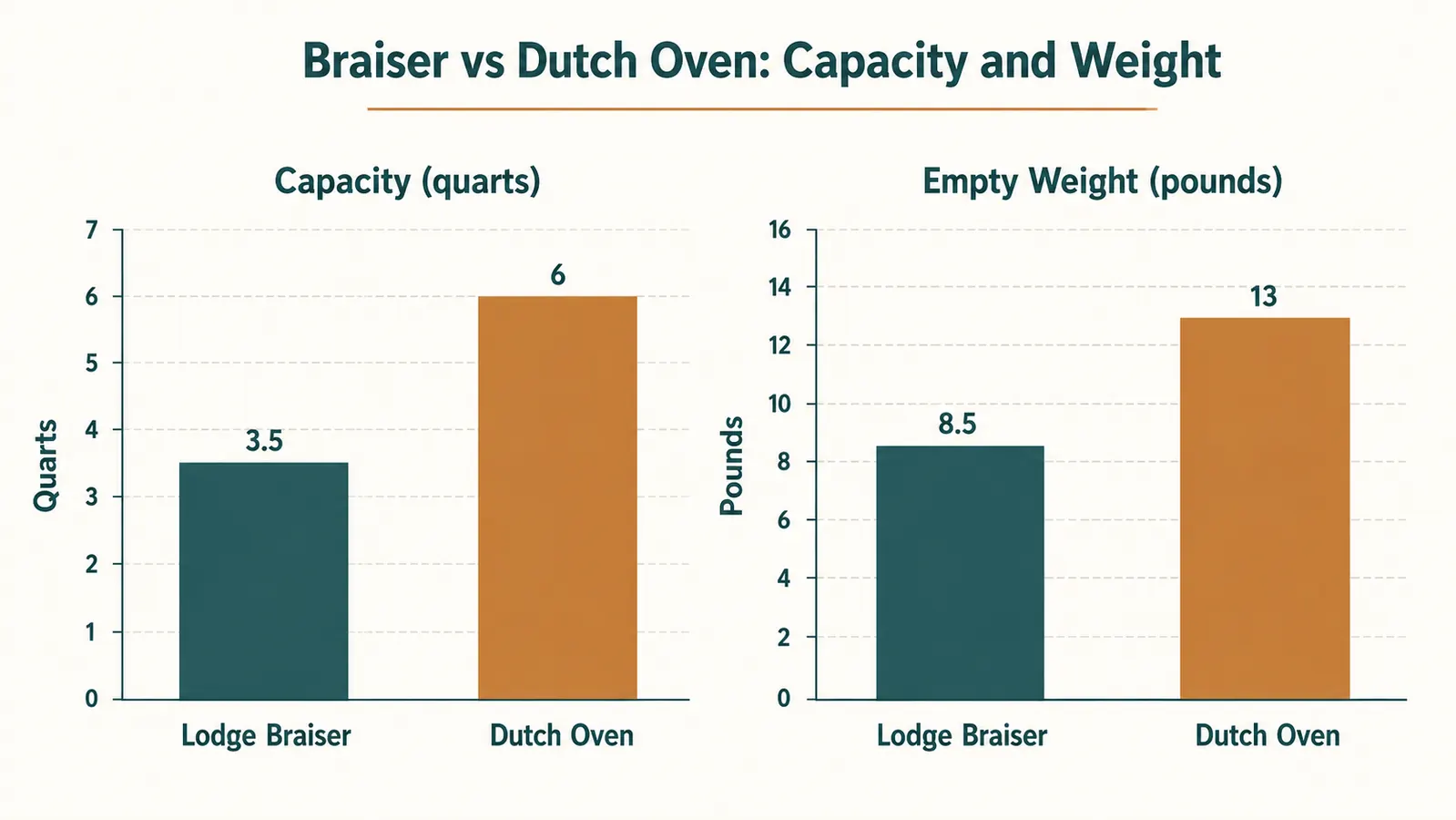
| Capacity | 3.5 quarts, sized for 2 to 4 servings | 6 quarts, sized for a full table or double batches |
| Empty Weight | About 8.5 pounds, lifts off the stove with one hand | About 13 pounds empty, before anything's even cooking in it |
| Interior Depth | Shallow, close to 3 inches, room for liquid to reduce and meat to actually brown | Deep, over 5 inches, built more for stock and soup than searing |
| Cabinet Footprint | Sits on a single shelf, a sheet pan can stack right on top | Needs its own shelf, most cabinets fit one and nothing else |
| Max Oven-Safe Temperature | 500 degrees, stainless steel knob handles high heat and broiling | Often capped near 400 to 450 degrees if the lid knob is phenolic, check before broiling |
| Best Suited For | Weeknight braises, searing, and one-pot meals for 1 to 3 people | Big-batch soup, stock, or bread baked under a lid |
| Handling Once Full | Light enough to tip and pour one-handed, even with liquid inside | Two hands recommended once it's full, especially moving it to the sink |
| Enamel Coating Durability | Holds up well with wooden utensils and a hand wash | Same enamel rules apply, holds up equally well with the same care |
Tired of a Dutch oven that eats a whole cabinet shelf?
The Lodge braiser sears, braises, and goes straight from stovetop to a 500 degree oven, sized for how most nights actually go.
Amazon Check Today's Price on Amazon →Where the Lodge Braiser Wins
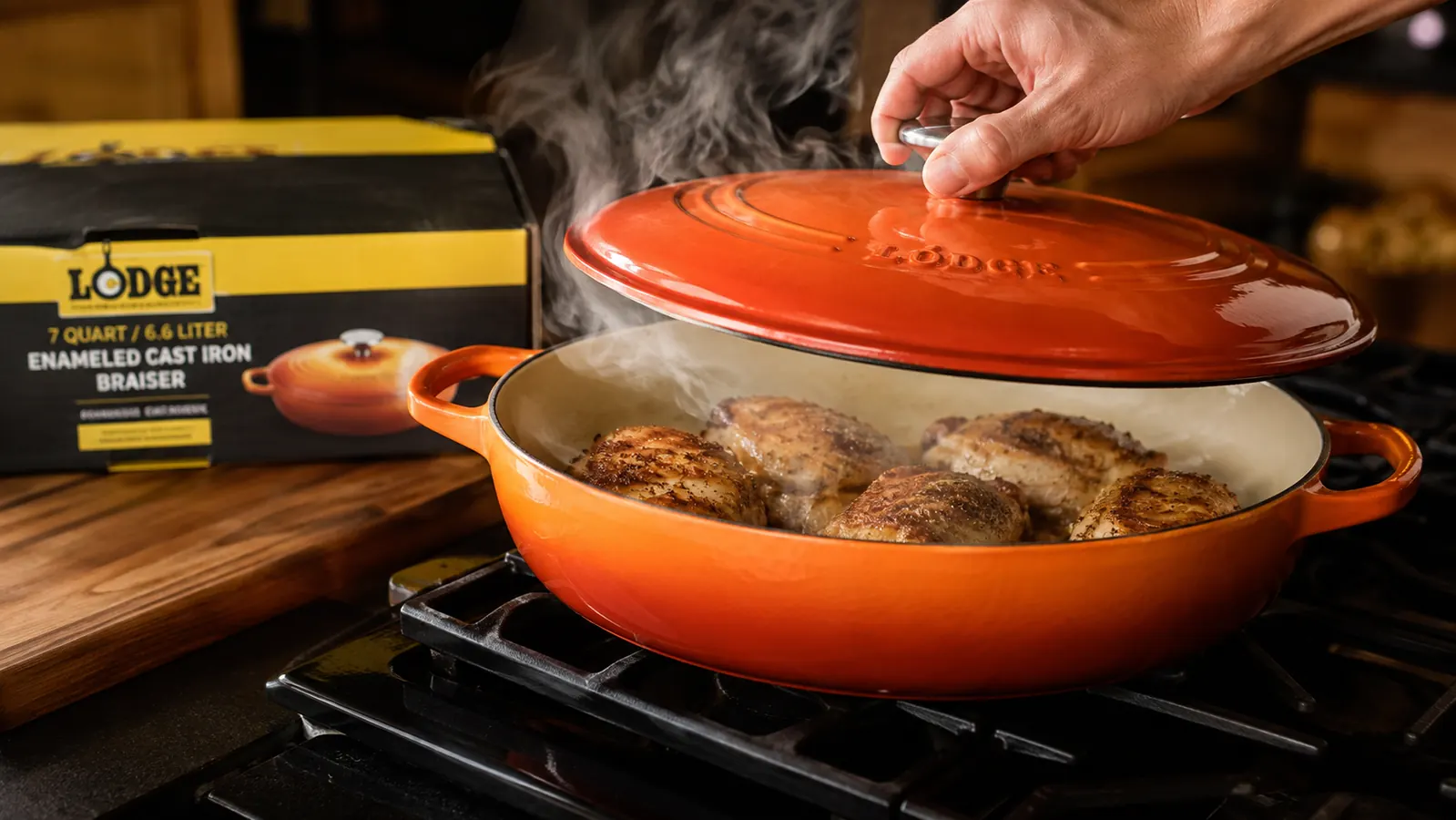
The braiser's real advantage is that it was designed as a two-in-one pot, not a scaled-down Dutch oven. The wide, shallow shape gives you more surface area in contact with the burner, which means a proper sear instead of the gray, steamed crust you get when a heavy pot crowds three chicken thighs into a space built for six. I brown meat in mine, deglaze right there, then slide the whole thing into the oven to finish, no second pan and no transferring anything. At 8.5 pounds empty it's also light enough that I don't dread lifting it, which matters more than it sounds like it should on a night when dinner is already running late. A pot I'm reluctant to pull out of the cabinet is a pot that doesn't get used, and that's true no matter how good the cast iron underneath it is.
Storage is the other place the Lodge pulls ahead. It sits flat on a single shelf and the lid can go right on top without stealing a second spot, so it lives next to my sheet pans instead of taking over its own shelf. I went deeper into the shelf math and why a smaller pot changes how a whole small kitchen gets organized in this piece on the braiser's counter and cabinet math. The other quiet win is the 500 degree oven rating with a stainless steel knob, so I can finish something under the broiler without worrying about melting a plastic handle, which is a real risk on some full-size Dutch ovens that ship with a phenolic knob rated well below that.
Where the Dutch Oven Wins
None of this means the braiser is the right pot for everyone. A 6-quart Dutch oven holds close to double what the braiser does, and when I'm making stock, a big pot of chili for a group, or bread baked under a lid, that extra volume isn't a luxury, it's the whole point. Try to fit six quarts of soup into a 3.5-quart braiser and you'll be ladling out half of it before it even comes to a simmer, or cooking two smaller batches back to back, which erases any time you saved by owning the smaller pot in the first place. The deeper walls on a full-size Dutch oven also hold heat differently, better for long, slow simmers where you want the liquid to reduce slowly rather than fast, shallow evaporation.
The bigger pot is also the better choice if you only want to own one piece of enameled cookware and need it to do everything, feed a crowd for a holiday, hold a double batch of soup for the freezer, and still braise a small roast on a regular Tuesday. It can do all three, just less efficiently than a pot sized for each job. What you give up is convenience on an ordinary night. A 13-pound pot, full of anything, is a two-handed lift, and pulling it out of a low cabinet after a long day is its own kind of chore. If you're set on the bigger pot, know that going in, because the tradeoff is real.
The braiser is built for the meal I actually cook most nights. The Dutch oven is built for the meal I cook four times a year. I only have room to keep one of them on an open shelf.
Storage and Cabinet Math
I measured both pots before I let myself buy either one, because I'd already made the mistake once of buying cookware that looked reasonable in a product photo and turned out to eat an entire cabinet shelf on its own. The braiser is roughly 11 inches across including the handles and about 4 inches tall with the lid on. A 6-quart Dutch oven runs closer to 12 to 13 inches across and 6 to 7 inches tall, and that height difference matters more than the width. A shelf that comfortably fits the braiser plus a stack of sheet pans on top of it will only fit the Dutch oven, alone, with nothing else stacked above, and I learned that the hard way after rearranging the same cabinet twice.
If your kitchen has one deep cabinet shelf to spare and nothing else competing for it, the Dutch oven's size stops being a real problem. If you're working with the kind of narrow galley kitchen where every shelf already has a job, the smaller footprint is the difference between a pot that gets used weekly and one that migrates to a closet after the first month. I wrote about the story behind why I finally gave up on owning a full-size Dutch oven at all in this piece about downsizing my cookware, if you want the longer version of how I got here.
What Each One Actually Cooks Well
Braising a chuck roast, a small pot roast, or bone-in chicken thighs, the braiser does this as well as any pot I've used, full stop. The shallow shape means more of the meat sits in direct contact with the hot enamel during the sear step, and the tight-fitting lid holds moisture in during the long oven finish. For two to four servings, I reach for it without thinking about it. Where it struggles is volume cooking, a full pot of chili for eight people, or a double batch of stock meant for the freezer. I've pushed it past 3.5 quarts exactly once, and half the liquid ended up on the stovetop instead of in the pot.
The Dutch oven is the better choice the moment a recipe calls for volume rather than surface area, stock made from a whole chicken carcass, a big-batch soup that needs to simmer for hours, or no-knead bread baked covered at high heat, where the deep walls trap steam better than a shallower pot can. I detail the exact braising method and timing I use, including where the two pots would diverge on the same recipe, in this step-by-step guide. If bread and stock are a regular part of your cooking and braising is occasional, the math tips toward the bigger pot.
Long-Term Care and What Wears Out First
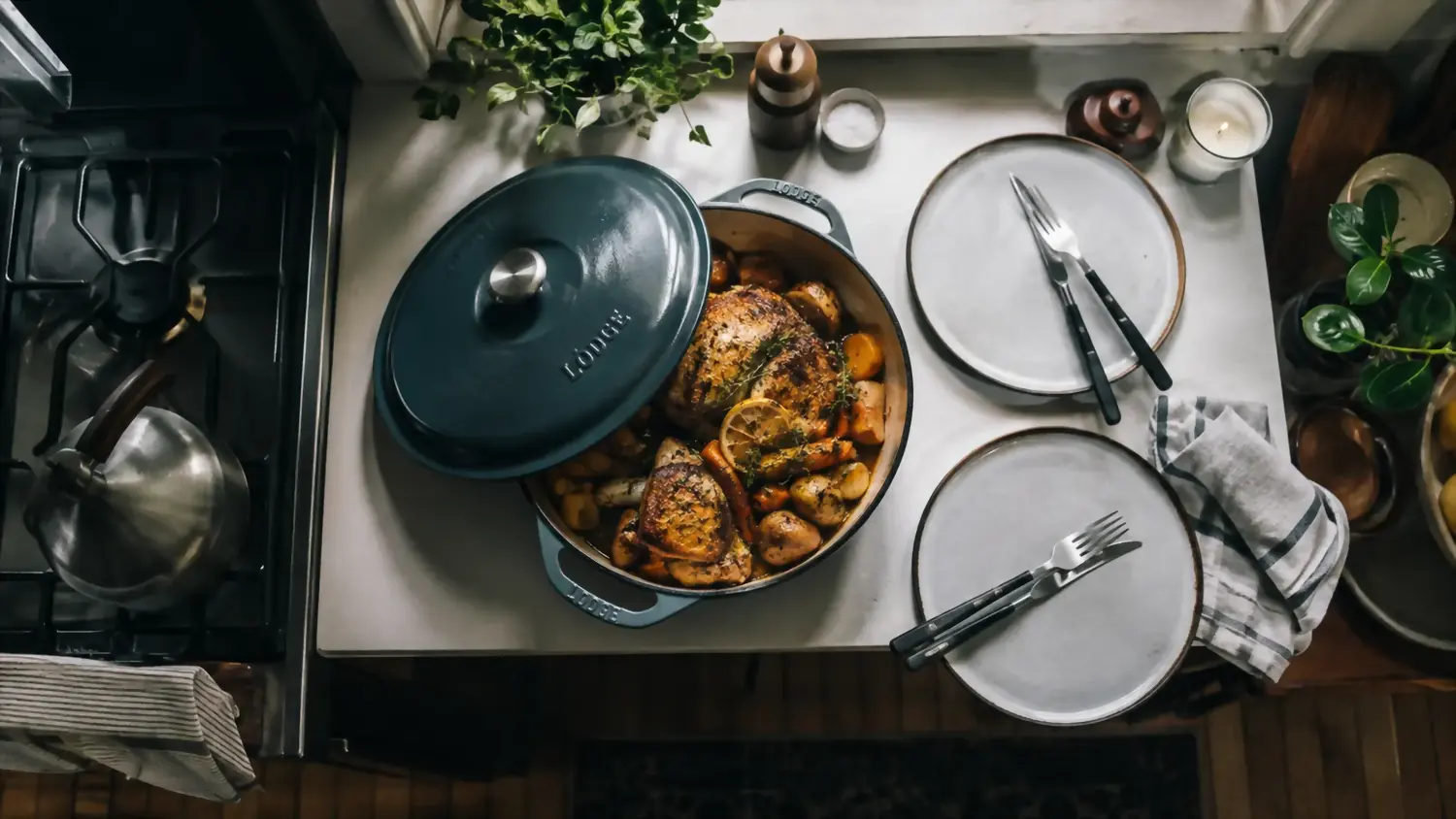
Enameled cast iron fails the same way regardless of size or brand, chipped enamel from a metal utensil dropped in hot, or thermal shock from setting a hot pot straight into cold water. I treat both pots the same way, wooden or silicone tools only, and I let either one cool most of the way down before it touches the sink. Over a year of regular use, the braiser's enamel interior has darkened slightly where I sear most often, which is normal staining rather than damage, and it wipes cleaner with a little baking soda and a soft scrub if it starts to look dull. I check the rim and the lid edge every few months, since that's where a dropped utensil does the most damage.
The Dutch oven's enamel holds up under the same rules, there's nothing about a bigger pot that makes the coating more fragile or more durable. What does wear differently is the exterior enamel on the handles and the lid knob, which take more knocks on a heavier pot simply because it's harder to set down gently when both hands are full. If you want the unfiltered version of what a year with the Lodge actually looked like, including the one spot where the enamel did chip on mine, I laid it all out in this honest review.
Who Should Buy Which
Buy the Lodge braiser if you're cooking for one to three people most nights, if your cabinet space is already spoken for, and if braising, searing, and one-pot dinners make up most of your cooking. Buy a full-size Dutch oven if you regularly cook for a crowd, make stock or soup in real volume, or bake bread under a lid, and you're willing to give up a full shelf and a two-handed lift for that capacity. I kept the Lodge on my open shelf and never replaced the stockpot I gave away, and I still don't miss it, even on the nights I'm cooking for company. If your week looks more like mine than like a holiday dinner, I'd make the same trade again. For the longer story of six straight months with this pot, I wrote it up in this long-term review.
Small kitchen, small batches, one pot that does both jobs.
See if the Lodge braiser is in stock and check today's price before you commit to a bigger pot you'll only use four times a year.
Amazon Check Today's Price on Amazon →