
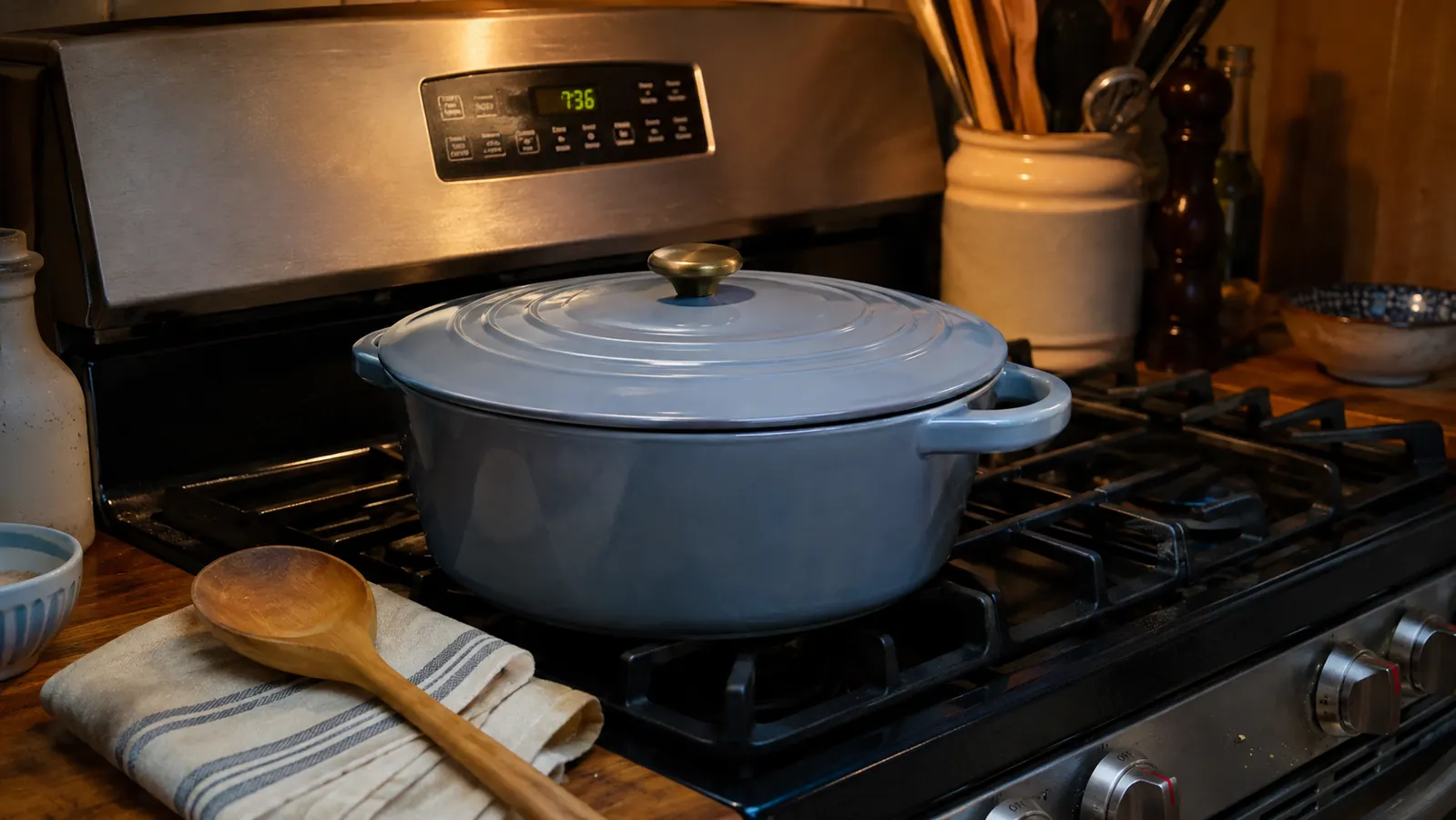
I bought the Lodge Essential Enamel Braiser last June, not because I had a plan for it, but because a short rib recipe I wanted to try called for a heavy pot with a tight lid and I didn't have one. My old stockpot was thin aluminum, the kind that scorches the bottom of anything simmered longer than twenty minutes, and I'd burned enough dinners on it to stop trusting it with anything that needed real time on the stove. The Lodge braiser was the first piece of enameled cookware I'd ever owned, and I picked the 3.5 quart size specifically because my kitchen has about two feet of usable counter and a cabinet that already felt crowded before I added anything new to it.
A year later, that pot has replaced three other pieces of cookware I used to reach for separately: the stockpot for soup, a smaller saucepan for rice and grains cooked in broth, and a cast iron skillet I used almost exclusively for browning meat before it went into the oven. I cook most nights, but not on any kind of fixed schedule, some dinners start at six and some don't start until closer to nine, and this review covers what a full year of that unpredictable routine actually did to the braiser, not a few weeks of careful, camera-ready use.
The Quick Verdict
A genuinely versatile enameled pot that goes from stovetop sear to oven braise to fridge storage without a single extra step, it earned a permanent spot on my stove after a year of near-daily use, though its weight and its 3.5 quart capacity mean it isn't the right single pot for everyone.
Amazon Check Today's Price →Tired of babysitting a thin pot that scorches the second you look away?
See today's price and current availability for the Lodge Essential Enamel Braiser on Amazon before you decide.
Amazon Check Today's Price on Amazon →How I've Used It
I didn't run this pot through a controlled test. I ran it through an actual year: weeknight chicken thighs braised in whatever half a jar of something needed using up, lentil soup on cold nights, and pot roast on the rare Sunday I actually plan a meal instead of improvising one at eight at night. The Lodge braiser sits on my stovetop, not in a cabinet, because for most of that year it's been the pot I reach for automatically before I even think about what else is available.
The routine that stuck was almost always the same shape. Sear something in the braiser directly on the stovetop, usually chicken thighs skin side down or a chuck roast in chunks, then add liquid, cover, and either finish it on low heat or slide the whole pot into the oven. That one-pot, stovetop-to-oven movement is the entire reason I bought enameled cookware instead of another stainless pot, and it's held up exactly the way I hoped for a year of nights that didn't always go according to plan.
What surprised me is how often I've used it for things that aren't braises at all. Weeknight soup happens in it more than actual braised meat does, and I've used it to bake a no-knead bread a handful of times on weekends when I had the patience for a slow rise. None of that is why Lodge markets this thing, but a pot that earns daily use outside its main job is worth more to a small kitchen than one that only does the one thing well.
The Enamel Coating and the Cornflower Blue Finish, One Year In
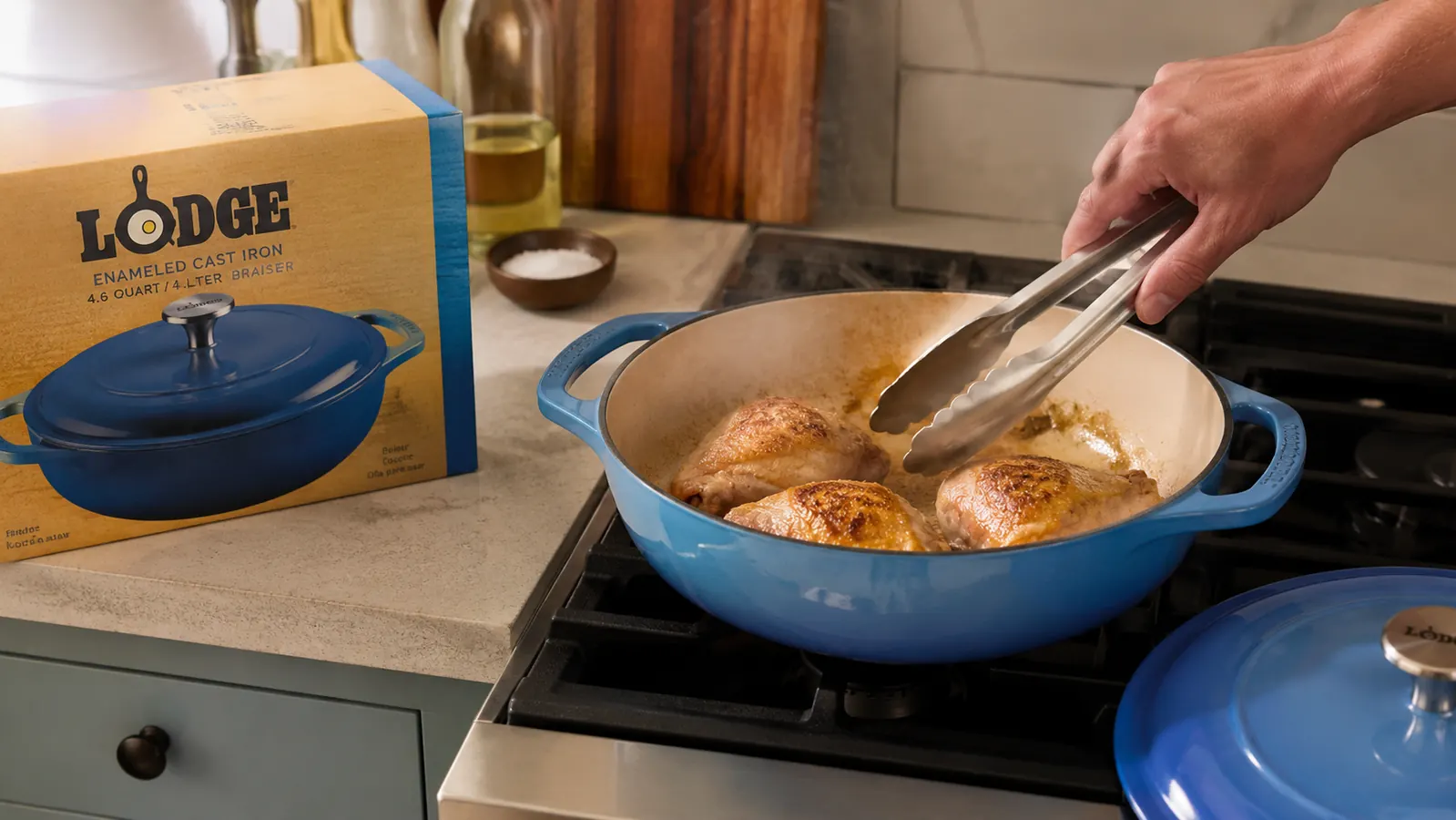
The enamel coating is the detail that decides whether a pot like this is worth the cabinet space, and it's the part I was most skeptical about going in. I'd read enough about enameled cast iron chipping along the rim if you're careless with a metal spoon, and I am, by my own admission, not always careful. A year in, the cornflower blue finish on the outside hasn't chipped anywhere, and the cream interior enamel has darkened slightly where I've browned meat over high heat most often, but it hasn't cracked, stained permanently, or lost its nonstick-adjacent smoothness.
I did stain it once, badly, with a tomato-heavy braise I left sitting overnight instead of washing right away. A baking soda soak the next morning brought most of it back, though if I hold the pot at the right angle under a bright light I can still see a faint shadow where that stain sat longest. It's not visible in normal use and it hasn't affected how anything cooks, but I'm mentioning it because nobody mentioned it to me, and I'd rather you know going in than find out the way I did.
The interior enamel does scratch if you use metal utensils aggressively, which I only figured out after a few months of using a metal spoon out of habit from years of stainless steel pots. I switched to wood and silicone once I noticed the fine scratch marks building up, and the scratching stopped. It's not a flaw in the Lodge itself, it's a habit change, but it's the kind of thing a first-time enameled cookware owner won't know to avoid until it's already happened.
From Stovetop to Oven to Fridge: How It Performs Across a Whole Meal
The part of this pot I didn't expect to matter as much as it does is the refrigerator safety. Because the braiser goes straight from oven to fridge without transferring anything to a separate container, leftover braises just live in the pot, lid on, until I reheat the whole thing two nights later on the same burner it started on. That single habit has cut down on dishes more than almost anything else in my kitchen, since there's no extra container to wash and no risk of forgetting something in the back of the fridge in a container I can't see through.
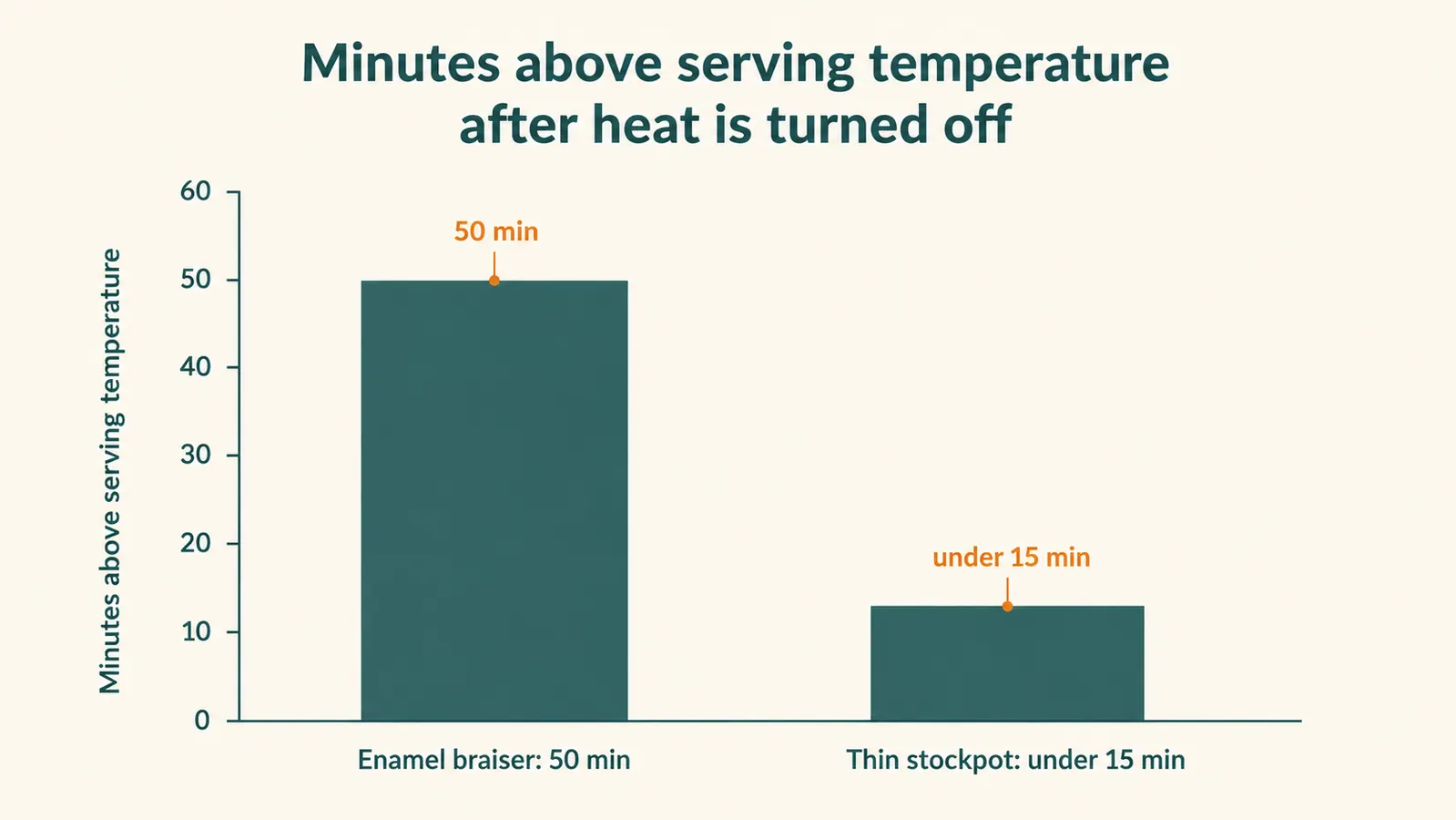
Heat retention is real, and it's the thing that makes the keep-warm behavior work without any electronics involved. Once something's been simmering in this pot for twenty or thirty minutes, turning the burner off and walking away for a while doesn't cool it down the way a thinner pot would. By my own rough timing with a kitchen thermometer, a braise stayed above serving temperature for close to 50 minutes after I turned the burner off, compared to under 15 minutes with the thin stockpot I used to own. On a night dinner got pushed back by almost an hour because of something that had nothing to do with cooking, the braise I'd started was still hot enough to serve when I finally sat down.
Induction compatibility mattered more than I expected once I actually used it. I don't have an induction stove myself, but I house-sat for two weeks last winter for a friend who does, and the braiser worked on it without any adapter or workaround, which meant I didn't have to pack a second pot for two weeks away from my own kitchen. That's a narrow use case, but it's the kind of detail that tells you the pot was built to actually be used across different kitchens, not just photographed in one.
The Weight, and What It Replaced in My Cabinet
I have to be honest about the weight, because it's the single biggest adjustment period this pot required. Empty, it's heavier than any other pot I own, and full of braising liquid and a few pounds of meat, lifting it out of the oven with two hands has become an actual habit, not an optional precaution. If you have any wrist or grip issues, or you're used to lightweight nonstick cookware, this is worth trying to hold in a store before you commit to it, because the weight is not a minor detail once you're moving it in and out of an oven regularly.
What it replaced, though, made the weight worth adjusting to. Before the Lodge braiser, my small kitchen had a thin stockpot for soup, a mismatched saucepan for anything cooked in broth, and a cast iron skillet for searing, three separate pieces of cookware taking up cabinet space I didn't have much of to begin with. Consolidating that down to one pot that handles all three jobs freed up an entire shelf, which in a kitchen this size is a bigger deal than it probably sounds.
The 3.5 quart capacity is the other tradeoff worth naming plainly. It's enough for two to three servings with leftovers, which fits how I actually cook, but if you're regularly feeding a family of four or more, you'll be running closer to the edge of what this size can hold, especially for anything with a lot of vegetables added to the pot along with the meat.
What I Considered Before Buying
Before I bought this specific size, I looked hard at a full-size Dutch oven instead, the kind that holds six or seven quarts and shows up in most braising recipes as the default. I ended up testing both side by side for a stretch and wrote the full comparison in my braiser versus Dutch oven breakdown, which covers the weight and storage differences in more depth than makes sense to repeat here. The short version is that the braiser's lower profile fits my cabinet in a way a taller Dutch oven never would have, but a full-size Dutch oven still makes more sense if you regularly cook for a bigger group.
I also spent a while trying to talk myself into just keeping the mismatched pots I already had instead of spending money on something new, and I wrote about how that decision actually played out in the story of the pot that replaced four pans in my kitchen. If you're on the fence the way I was about whether consolidating cookware is worth it, that's the more personal version of this same year.
What I Liked
- Enamel coating hasn't chipped on the exterior after a full year of regular use
- Goes from stovetop sear to oven braise to fridge storage in the same pot, cutting cleanup dramatically
- Heat retention keeps a finished braise warm well past the point a thinner pot would cool
- Consolidated three separate pots into one, freeing up real cabinet space
- Worked without issue on an induction stove during two weeks away from my own kitchen
Where It Falls Short
- Heavier than any other pot I own, lifting it full out of the oven takes two hands
- 3.5 quart capacity is a real ceiling for feeding more than two or three people
- Interior enamel scratches with metal utensils, wood or silicone is required
- A tomato-heavy braise left overnight stained the interior enough that a faint mark is still visible at the right angle
I didn't buy this pot to fall in love with cooking again. I bought it because I was tired of washing three pots for one meal, and a year later that's the part that actually changed.

Who This Is For
If you're cooking for one or two people in a kitchen where cabinet space runs out fast, and you're tired of pulling out three different pots for a single meal, the Lodge braiser earns its spot. It's built for someone who wants one pot that goes from stovetop to oven to fridge without extra steps, not someone assembling a full set of matching cookware. If you want the fuller case for why an enameled braiser beats a bulkier setup in a small kitchen, I laid it out in this list of reasons an enameled braiser beats a bulky Dutch oven.
Who Should Skip It
If you're regularly cooking for a family of four or more, the 3.5 quart capacity will frustrate you the same way it would frustrate anyone trying to stretch a small pot too far, and a full-size Dutch oven is the more honest choice. If wrist strength or grip issues make a heavy full pot hard to lift safely, it's worth testing the weight in person before buying. For the sharper edges I didn't spend as much time on here, I wrote a more unfiltered breakdown in my honest review of the 3.5 quart pot.
If three pots for one meal has worn you out, this is what stopped it
Check today's price on the Lodge Essential Enamel Braiser and see if it's in stock for your kitchen.
Amazon Check Today's Price on Amazon →