
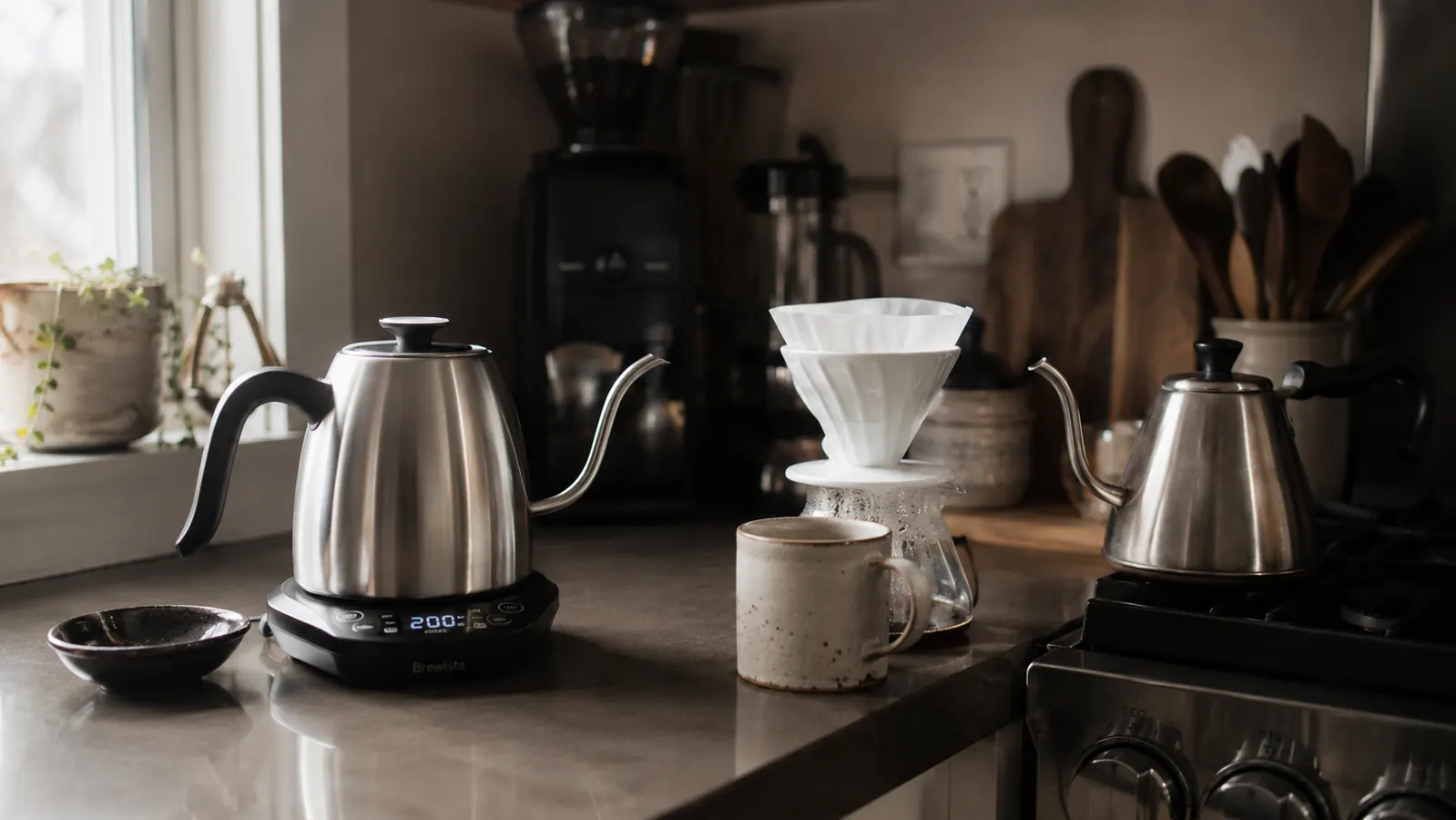
I get asked this more than almost anything else about my kitchen setup: electric gooseneck or stovetop gooseneck, and which one do I actually reach for. Short answer, I use the Willow & Everett kettle most mornings, and I keep a plain stovetop gooseneck kettle in the cabinet under the coffee station for the days that don't go as planned. They are not the same tool wearing different metal. One plugs in and holds a number until you're ready. The other sits over a flame and asks you to pay attention to it. If your mornings run on a schedule that shifts by the hour, that difference matters more than the shape of the spout.
For this comparison I used the Willow & Everett gooseneck electric kettle, the 0.8 liter stainless model with the digital temperature presets, against a Bonavita stovetop gooseneck kettle, the kind that shows up in most pour-over guides that assume you already own a reliable burner and a separate thermometer. Both have the long, thin curved spout that lets you control the pour instead of dumping water straight onto the grounds. Past that, they solve two different problems. One is about not having to think while the coffee brews. The other is about not adding another appliance to the one outlet by the coffee station. If you want the deeper case for why a gooseneck kettle earns its space over a basic one at all, I laid out ten reasons here.
| What Matters | Willow & Everett Electric Kettle | Stovetop Gooseneck Kettle |
|---|---|---|
| Heat Source | Built-in digital base, plug in and press start, no burner needed | Needs a working stovetop burner, ties up that burner while it heats |
| Temperature Control | Digital presets from 122 to 212 degrees, holds the number until you pour | No readout at all, you judge readiness by sound and steam |
| Time to a Full Boil | About 6 minutes for a full 0.8 liter fill from cold tap water | About 9 minutes over a medium-high gas burner, longer on electric coil |
| Outlet Dependency | Needs its own open outlet and a few inches of clearance around the base | Needs nothing but a stove, works during a power outage |
| Portability Off the Grid | Useless without electricity, stays home if you're camping or on a camp stove | Works over any open flame, packs into a camping kit without issue |
| Upfront Cost | Costs more upfront, in the higher range for a countertop electric kettle | Costs less, closer to the price of a plain stainless pot of similar size |
| Cleanup | Base and cord must stay dry, hand wash the kettle body only | No electronics to protect, dishwasher-safe on most stovetop models |
Where the Willow & Everett Kettle Wins
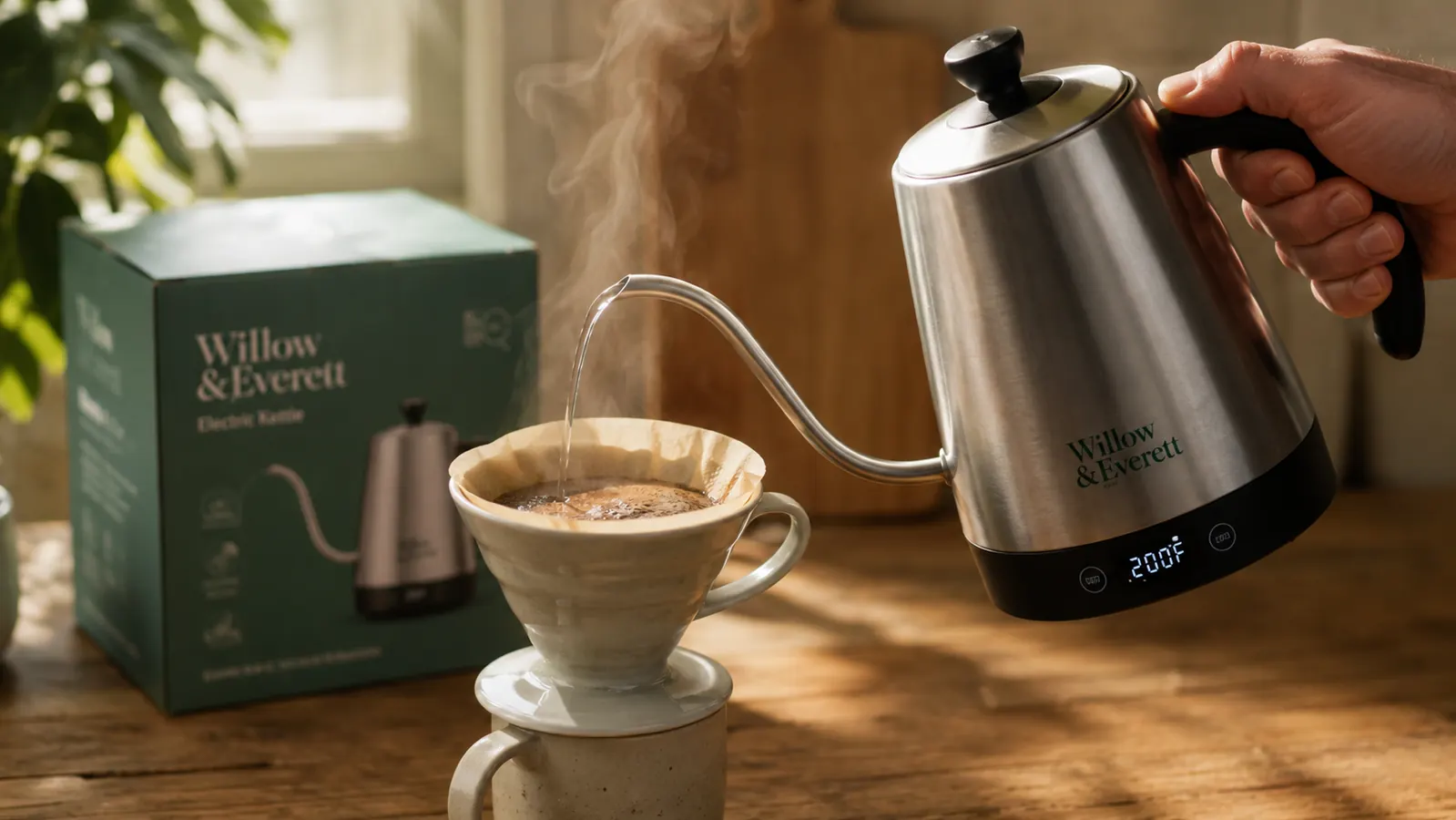
I burned more than one pot of pour-over water learning what a near-boil sounds like on a stovetop kettle with no whistle to warn me, and I still get it wrong about one morning in five if I'm not standing right there watching the steam. The Willow & Everett kettle removes that guessing entirely. I set it to 205 degrees for a medium roast, walk off to grind beans or find a mug, and come back to water sitting exactly where I left it, held on the keep-warm setting instead of climbing past the point where it scorches the grounds. For a kitchen where my attention gets pulled three directions before the coffee's even started, that's the whole argument in one feature.
Speed is the other real win, and it's not close. A full 0.8 liter fill hits boiling in about six minutes on the Willow & Everett kettle's base, against roughly nine minutes on the stovetop version over a decent gas burner, and longer than that if your stove is an old electric coil that takes its time coming up to heat. Three extra minutes doesn't sound like much until you're doing it on a morning where you're already running behind, and it stacks up fast over a year of daily use. The digital shutoff is the quieter win underneath that one. I've walked away from the stovetop kettle and come back to a burner still running under an empty pot more than once. The electric base shuts itself off. It doesn't forget.
The gooseneck spout itself performs better on the electric version too, though that's partly a function of the base doing the temperature work for you. Because the water is already at the exact number I want before I start pouring, I'm not trying to read steam and judge readiness and control a slow circular pour all at the same time. That's three jobs at once on a stovetop kettle. The electric base takes one of them off my hands, which leaves more attention for the pour itself, and a better pour is most of what separates a flat cup of coffee from a good one. I get into the full six-month picture, including how the coating and the hinge on the lid have held up, in my long-term review.
Repeatability is the part nobody mentions until they've lived with a kettle for a while. The stovetop version gives you a different result depending on how distracted you were that morning, whether the burner was set a notch higher than usual, whether you got pulled away mid-heat. The Willow & Everett kettle gives me the same 205 degrees on a Tuesday that it gave me the Saturday before. That consistency is what actually changed my coffee, more than any single brew method tweak I tried before I switched. A kettle that behaves the same way every single time turns out to matter more than a kettle with a slightly nicer handle.
Where the Stovetop Kettle Wins
The stovetop kettle's biggest win is that it asks nothing of your kitchen except a burner you already have. No dedicated outlet, no base taking up its own patch of counter, no cord to route around. In a kitchen where the counter runs out before the ambition does, a kettle that lives on the stove or hangs on a hook by the burner is a real advantage. I've moved the stovetop kettle between three different kitchens over the years without a second thought. The electric base is pickier. It needs a flat spot near an outlet, and if that outlet's already claimed by a toaster or a coffee grinder, you're rearranging your whole counter to make room for one more plug.
Cost and durability are the other honest wins for the stovetop side. A plain stainless stovetop kettle is a simpler object, no circuit board, no digital display, no base to fail. If it drops or gets knocked around, you're looking at a dent, not a dead appliance. It costs less to replace, and there's less inside it that can break in the first place. It's also dishwasher-safe on most models, since there's no electronics to protect from water, where the Willow & Everett kettle's body needs a hand wash and the base needs to stay bone dry, which is one more thing to remember on a morning when remembering things isn't going well.
There's also a simplicity to handing a stovetop kettle to someone else. My mother-in-law can use mine without instructions, put it on the burner, turn the knob, listen for the change in sound. Handing her the Willow & Everett kettle means a five-minute explanation of presets and a keep-warm button she'll forget by the next visit. For a kettle that lives in a house with more than one person making coffee, or gets used by guests who aren't going to read a manual, the stovetop version's total lack of a learning curve is worth something real.
The electric kettle is a tool that takes work off your plate. The stovetop kettle is a tool that asks nothing extra of your kitchen. Most mornings I want the first one. On the mornings the power's out, I'm glad I still own the second.
Tired of guessing when the water's actually ready? Set the number and walk away.
The Willow & Everett kettle holds your temperature until you're ready to pour, no thermometer, no burner watching required.
Amazon Check Today's Price on Amazon →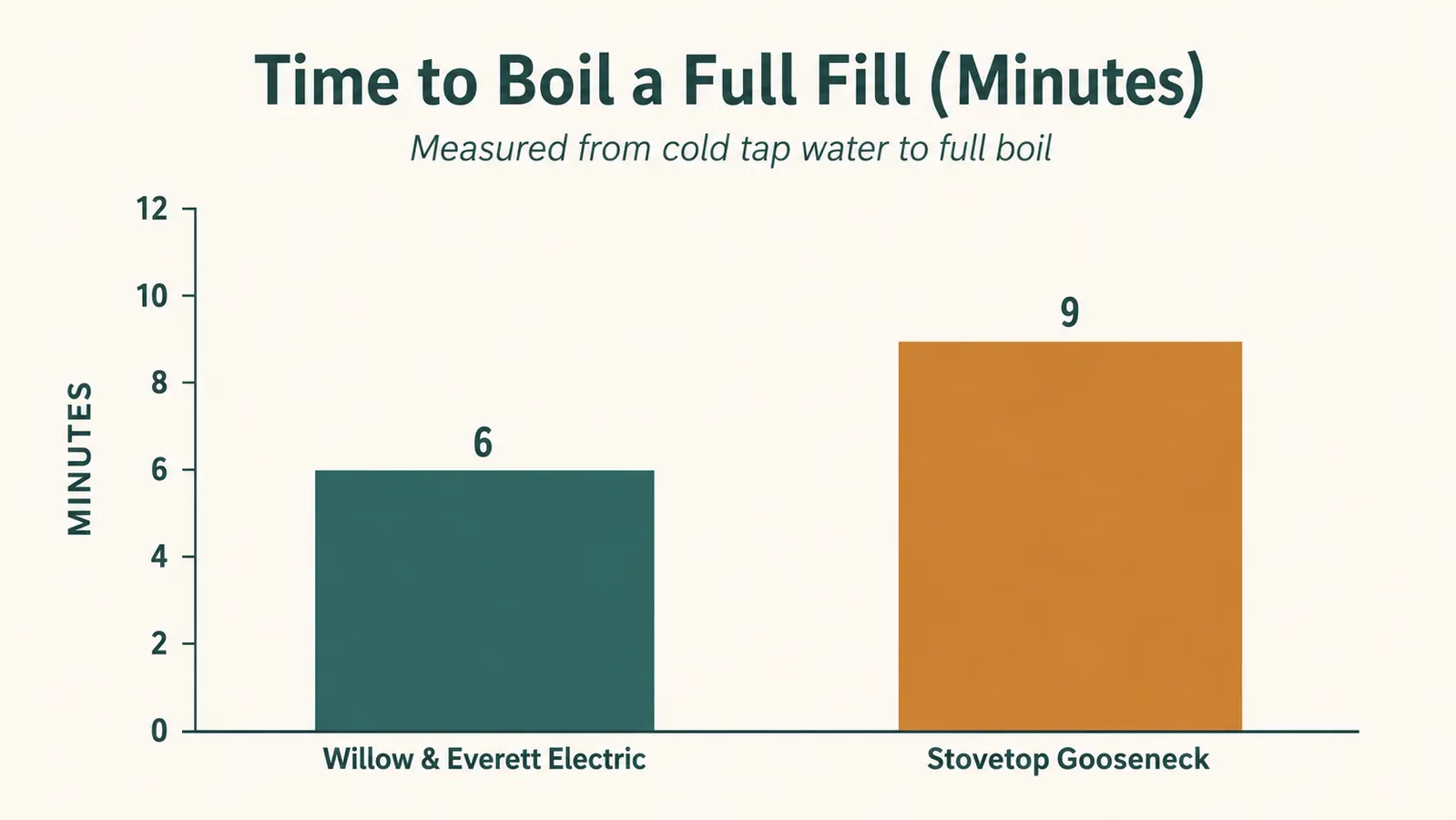
What I Actually Use Each For
On a normal weekday, the Willow & Everett kettle is the one that's plugged in and doing the work. I brew one cup, sometimes two, at whatever hour I actually get to it, and I don't want to be standing over a burner watching for the exact moment the water's ready. The digital presets mean I can set it for green tea one morning and a pour-over the next without owning a separate thermometer or memorizing water temperatures I'll forget by Thursday. It's the appliance I don't have to think about, which after a few years of odd-hour cooking is the highest compliment I've got for anything in this kitchen. The exact routine I follow, water ratio and pour speed included, is in this step-by-step guide.
The stovetop kettle comes out for the situations the electric one can't cover. A power flicker during a storm, a stretch where I'm minimizing what's plugged in, or the rare weekend I'm making tea for four people and don't want to run the electric kettle twice through its 0.8 liter capacity. It's also the one I'd actually pack if I were taking coffee gear somewhere without an outlet. Neither kettle has replaced the other completely in my kitchen. They've just sorted themselves into different jobs, and knowing which one to reach for stopped being a question after the first few weeks. I told the longer story of how I landed on the Willow & Everett kettle in the first place in this piece.
Who Should Buy Which
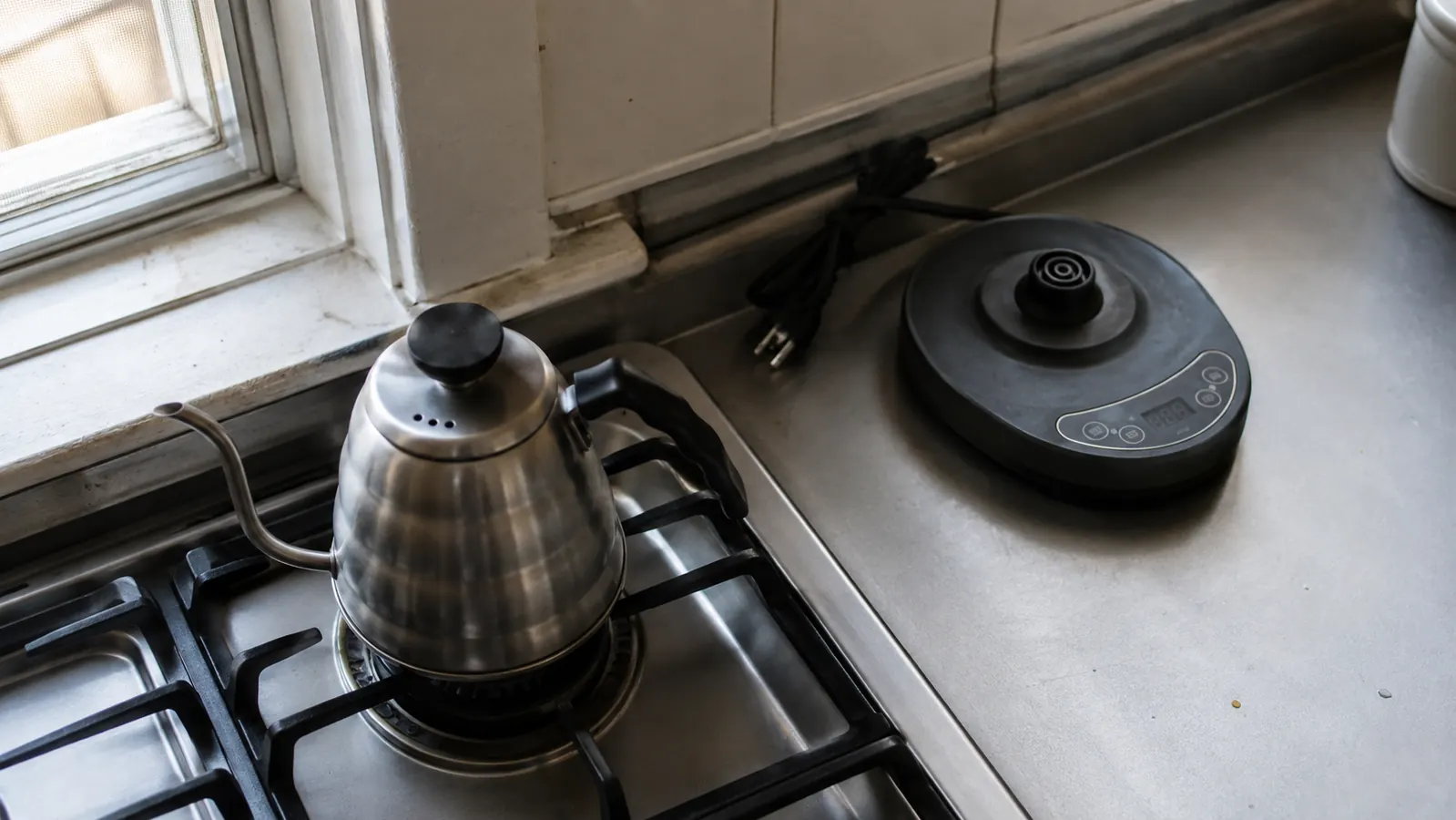
Buy the Willow & Everett kettle if your mornings are unpredictable, if you want a specific temperature instead of a guess, and if you brew coffee or tea often enough that six extra minutes a day, every day, actually adds up. It's the better fit for anyone whose counter has room for one more base and whose outlet situation can handle it. Buy a plain stovetop gooseneck kettle if your kitchen is already tight on outlets, if you want the cheapest reliable way into gooseneck pouring, or if you need something that works without power. I kept both. Most people don't need to, and if I had to choose just one, the Willow & Everett kettle is the one that stays plugged in. If you want the unfiltered rundown of what's gone wrong along the way too, not just what I like, I wrote that up in this honest review.
Stop babysitting a stovetop kettle that never tells you when it's ready.
Digital presets, a hold-warm setting, and a pour you can actually control. Check today's price and see if it's in stock.
Amazon Check Today's Price on Amazon →